
What is the best communication channel for our customers? Is it better to focus on a few channels and handle them perfectly, rather than having many and managing them halfway?
The question of which channels to use for communicating with customers has been around for a long time. Perhaps ever since emails joined telephones. Later on, web-chats slowly entered the scene. But it was only social media that totally disrupted the peaceful status quo in the world of communication.
The younger generation is gradually taking over the world. They reject established processes and classic communication channels. In their eyes, email is absolutely and unusable slowly. And the phone? A device from the century before last that you have to speak into out loud.
They fire off their inquiries in all directions using short messages across every messenger app imaginable. Meanwhile, a portion of the middle generation and seniors don't change their communication habits much, and suppliers naturally want to sell to the entire age spectrum.
This creates a bit of communication chaos. The long-proclaimed rule "fewer channels, but done right" is starting to lose its relevance. Very few companies today have such a tightly defined target group that they can get by with a limited range of channels.
Today's Communication Channels
Customers today have a truly wide variety of choices at their disposal:
phone
webchat
WhatsApp
FB Messenger
Instagram
SMS chat
This is just the absolute foundation; there are also other channels like Viber. Comments under social media posts and ads can also be counted as communication channels, and they deserve a quick and professional response too.
So, which channel is the best?
There is no single, simple answer to this question. We've already mentioned preferences based on the customer's age profile. Another major factor can be the supplier's field of business. On one hand, this attracts certain age groups. On top of that, different types of products can require different styles of communication.
The need for different communication styles stems from several factors:
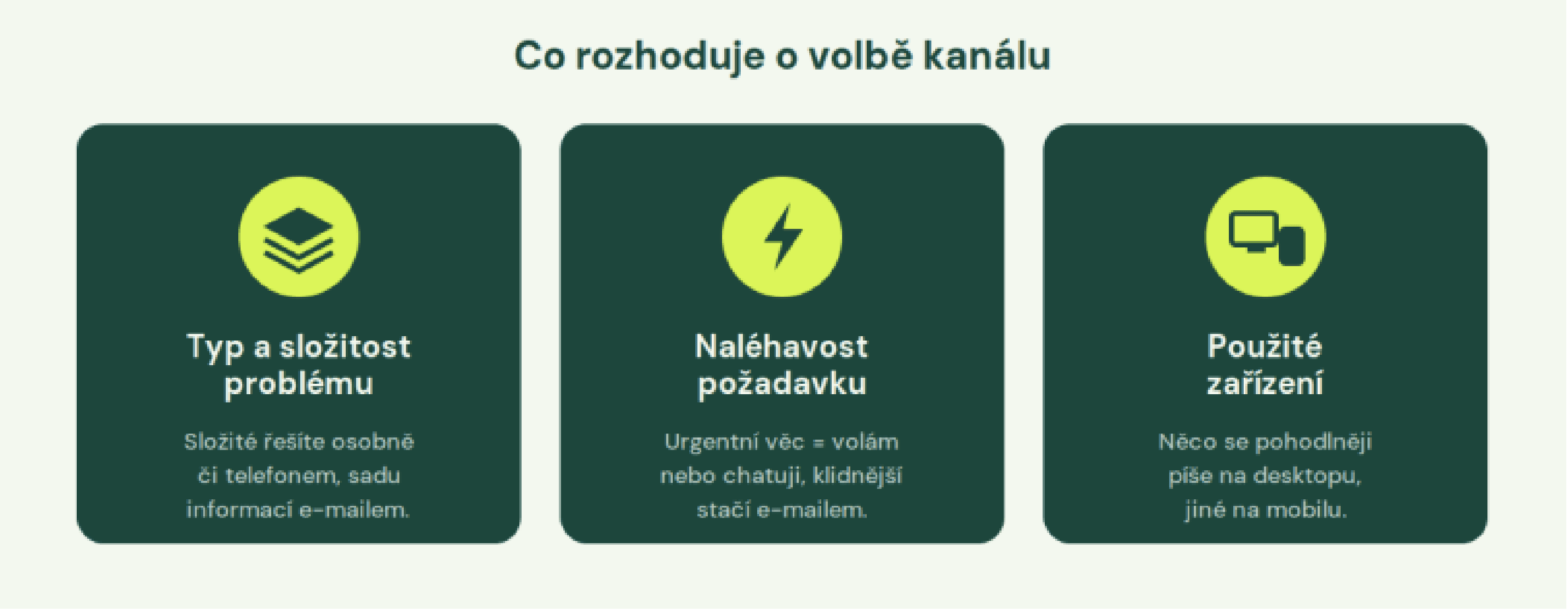
1. The type and complexity of the issue that needs to be solved
It's pretty obvious that complex issues are best discussed in person. A face-to-face meeting or video conference is the most effective way. These formats allow you to discuss and draw. Plus, you can easily see the reactions and emotions of everyone involved.
If a meeting isn't possible, or if the issue is slightly simpler, a phone call will do. In cases like these, where you are still looking for the right solution, email is not a great channel, for example.
Email is still a very good channel for situations where you need to hand over a more comprehensive set of information to the other party, such as meeting minutes. Email has another benefit too: users usually archive important emails and can easily refer back to them.
Short messages, as the name suggests, are not very suitable for delivering comprehensive information, but rather for minor reminders, updates, or, for example, a quick question about product availability or order status. This applies to pretty much all types of social media.
2. The urgency of the issue that needs to be solved
Based on our historical experience, we tend to box each channel—rightly or wrongly—into a certain response time:
Email – long response time, often left unanswered
Phone – usually a response within seconds
Chats and social media – again, typically responsive within seconds, or at most a few minutes
These experiences are changing significantly today with the massive adoption of AI (voicebots, chatbots). The experience can shift in a positive direction if the AI is implemented with high quality and a customer-centric focus. However, it can also go very negative if the communication is completely paralyzed by a "looped" bot.
The urgency of the problem also heavily influences the choice of channel:
If something is urgent, I call or start a chat
If I am just sending some follow-up info, I am perfectly happy with an email
3. The device used
Even though virtually all applications are available on both desktop and mobile today, some channels are simply easier and more pleasant to use on a desktop, while others feel better on mobile. This can also drive your customer's channel preference.
How to navigate this?
As we have shown above, communication is coming at us from all sides today. With varying expectations and response speeds. In reality, we are talking about at least three, more likely five to seven channels.
Every customer-oriented company should listen to this need from their customers. You should make it easy for them to communicate the way they prefer. Rather than forcing your perspective and your channel of choice on them.
In the past, the need to use multiple applications was a major barrier. It fragmented the communication. The price of running solutions for all these channels was often a barrier as well.
These barriers have long since fallen. Modern omnichannel helpdesks handle all communication channels in a single application. All your team members can jump right into it. And today, the price is more than friendly.