
Are we seeing the sunset of phone customer support, or are we on the brink of a renaissance for this communication channel?
For several decades, industry studies have been offering us the same forecast: within five years, email volume will drop significantly in favor of chat, and voice traffic will disappear completely. However, years go by, and customers are still calling and emailing businesses just as before - and companies are happily returning those calls and emails.
Why we still love using the phone
There are plenty of reasons why the phone remains a go-to tool:
It is the ultimate real-time tool, where you can always reach someone and resolve your issue right away.
It lets you talk through tricky details quickly. This is especially handy when a task isn't quite clear. Trying to handle this via email or chat would be a long, drawn-out process and highly inefficient.
If you are away from your computer, you can easily connect just by pulling up a contact—no need to squint at a tiny screen or struggle with typing. You can even stay productive while driving.
Many people simply prefer having a quick conversation over typing out a message.
Of course, a poorly set-up voicebot can make things tricky. If the bot gets stuck in a loop and can't help your customer reach their goal, the benefits of the channel are lost. But there is good news on this front! Today's voicebot implementations are much more customer-friendly than they used to be.
Hard-to-replace use cases
Beyond the general reasons, there are many specific situations where voice is king. The phone is perfect for people who can't look at a screen or take notes—like drivers or anyone constantly on the go. Entire industries also have their established habits. For instance, in the restaurant business, ordering ingredients over the phone remains standard practice.
Modern phone systems
Perhaps the biggest paradox in communication over the last few years has been the rise of mobile phones. Mobiles gave everyday users incredible freedom of movement. You can reach anyone, anywhere, at any time—and anyone can reach you.
In our private lives, that can be a great feature (even if most of us now value the ability to reach others more than being constantly reachable ourselves!).
In a business setting, mobiles are great for field staff who need to stay in touch internally. However, it’s a different story when a customer reaches them directly while they are out in the field.
For support departments, relying on mobile phones can be a bit of a disaster. Back-office teams have no way of knowing how many calls are actually coming in. They lose visibility into agent workloads, can't track missed calls, and have no idea if anyone is following up with call-backs.
Publishing individual staff members' mobile numbers also creates major issues. It completely eliminates backup options. Your top specialists end up overloaded with minor requests, and handling coverage during vacations becomes a real headache.
This is a common scenario in smaller companies with just a handful of employees. Mid-market and enterprise businesses usually have it better. Historically, they have used office phone systems (PBXs) to talk to customers. However, most of these systems act as isolated islands, without integrations to other tools. Call recordings are missing from the CRM, and there is often no record that a call even took place.
Even these larger companies struggle when mobile numbers "leak" to customers. For example, a consultant might step in to solve a complex issue, and from then on, the customer only calls them directly because they prefer their expertise over the standard support front line.
The voice channel renaissance, powered by AI
Artificial intelligence is bringing incredible new possibilities to the voice channel. This includes voice-controlling applications, filling out forms, or even placing orders entirely by voice.
Thanks to AI, handling actual calls is now much more efficient. Recordings can be automatically transcribed into text, summarized, and analyzed for customer sentiment. Based on the content and keywords, the call can even tag itself automatically.
This means voicebots can easily take care of routine customer queries, freeing up your team for more complex tasks.
What a modern phone system looks like
A modern phone system is built around a single contact number so your customers never have to guess who to call. Smart routing logic uses customer data from your CRM to ensure every caller is automatically connected to the right agent.
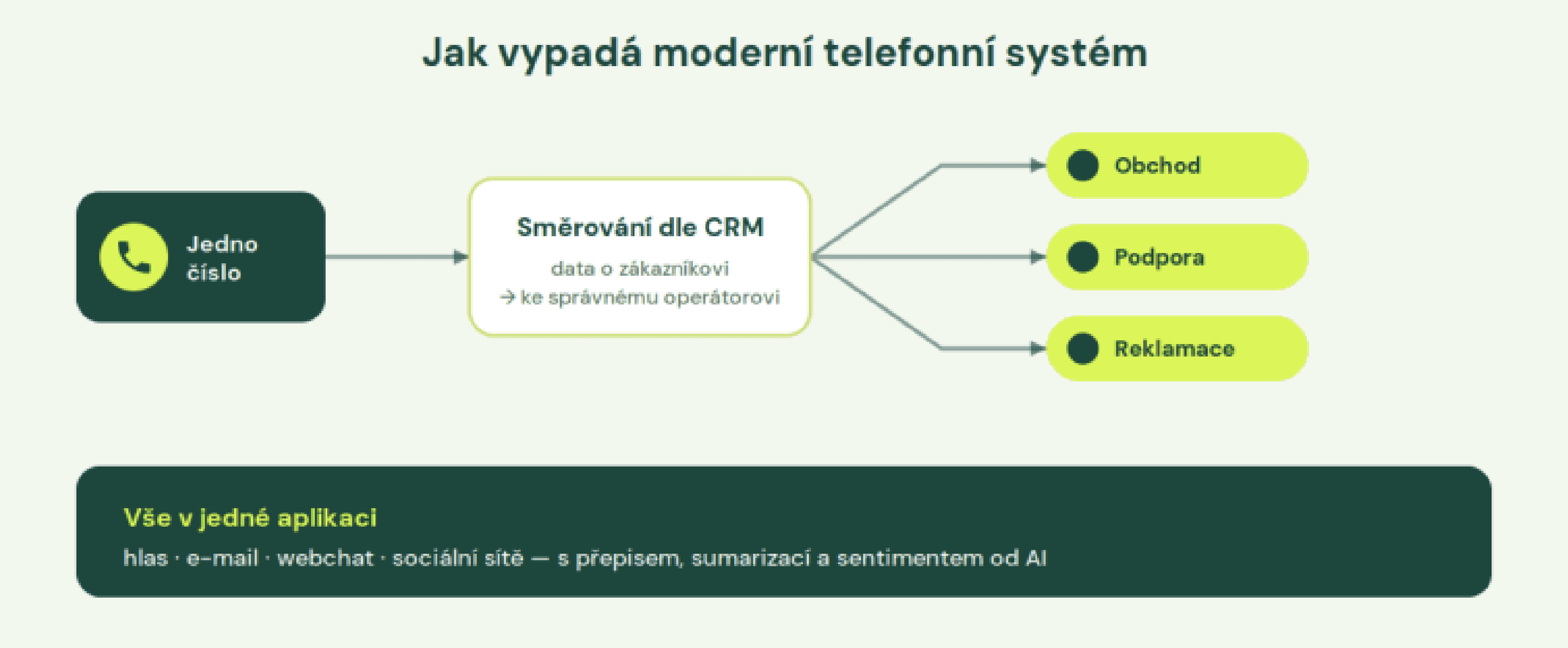
The voice channel is managed right inside the helpdesk alongside your other channels—like email, web chat, and social media. Everything is in one place, within a single application. This gives your business complete control over customer communications across all channels.
And the best news? The cost of these modern, AI-powered systems is now highly affordable, making them a great fit for businesses of any size.