
Once upon a time, a single email was all it took. Your business had one address, the customer sent over a question, and the entire conversation stayed neatly in one place. At most, they might escalate things with a quick phone call.
Times have changed, though.
Today, that same customer might start a chat on your website. The next day, they follow up with an email. Then, they think of something else and quickly shoot over a key detail via WhatsApp or FB Messenger. And if they haven't heard back by afternoon, they'll give you a call to check on the status.
To them, it’s just one continuous conversation. They naturally expect that whoever they talk to will keep the rest of the team in the loop. For your business, however, you end up with four separate conversations—often scattered across different systems and teams, with no linked history of the original issue.
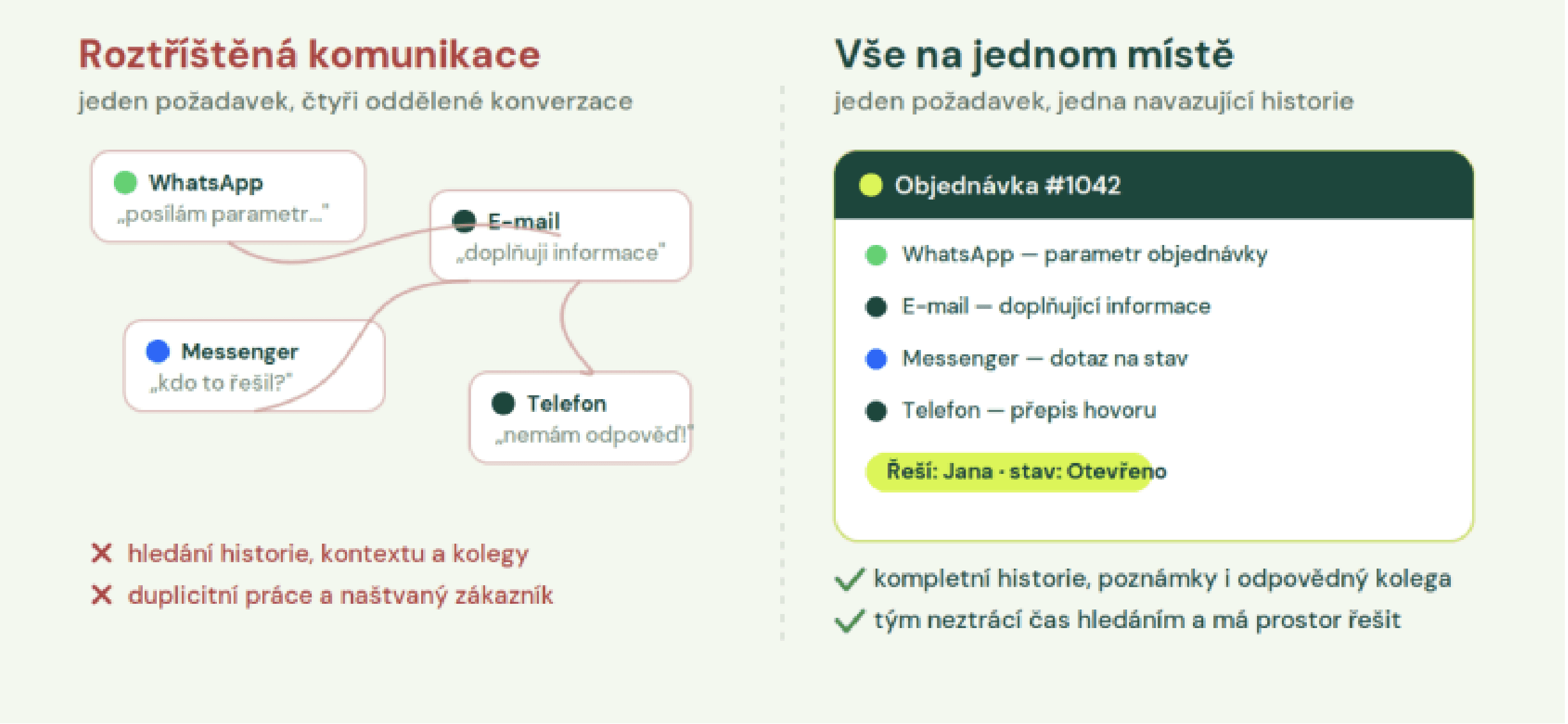
This leaves support agents juggling questions like:
Who already got back to them?
Where is the latest update?
Has someone else on the team already started working on this?
Customers don't worry about where to write—they just want to reach you
Today’s customers naturally switch between different channels. They choose how to reach you based on how urgent their request is, what device is handy, or simply what they prefer. Plus, habits vary from person to person. It is now completely normal to interact across all of these channels:
Email
Webchat
WhatsApp
FB Messenger and Instagram
Phone and SMS
Each channel adds a new touchpoint and piece of information. If these channels operate in silos, things get messy almost instantly. On top of that, customers might occasionally use unofficial channels that your team doesn't regularly monitor.
Yet, what your customer expects is simple: they want to feel like you know their history. They don't care whether they used Messenger or email, or who they spoke with last. They just expect a seamless, continuous conversation.
The real bottleneck isn't the volume of messages—it's the search for info
Many companies worry that they are getting too many requests for their team to handle. Usually, though, the real challenge lies elsewhere.
Your support team's time doesn't disappear when writing replies. It gets lost in the search. Searching for conversation history. Finding the teammate who handled the case. Locating the last message. Piecing together context. To make matters worse, this often happens when a customer is already frustrated. Agents then rush to solve a problem that could have been avoided in the first place.
What changes when you bring all channels into one place
Unifying your channels solves the biggest headache: your desktop support agents spend less time searching because they can find everything in one dashboard:
Complete interaction history across all channels
Previous replies from all team members
Internal notes and collaboration
The current status of the request
The agent assigned to the case
You can finally say goodbye to daily workflow frustrations like:
"Could you send me a screenshot of that message?"
"Do you happen to know who was working on this?"
"Where is that last email?"
"Can you check Messenger as well?"
Instead of digging through folders, your team gets the breathing room they need to focus on what really matters—solving customer issues.
It's not about working harder, but eliminating busywork
When trying to handle higher ticket volumes, businesses often think they need to hire more people or build complex new processes. Usually, though, the solution is simply removing the extra steps between receiving a message and replying to it.
As you add more communication channels, having them all in one shared inbox becomes essential. Down the line, you can easily plug in AI tools, but that's a story for another day. The first step is getting all conversations and agents onto a single platform. Once you have that foundation, automation is a breeze.